


Supported by the Department for Science, Innovation and Technology, we are expanding the Digital Help Finder — developed with Essex County Council — across the South of England. Four new local authorities will join Essex in delivering the platform to their residents, each operating their own data environment. Together, a shared pseudonymised dataset will power a new model for calculating the social return on investment in digital skills, giving local authorities and their partners the evidence they need to make compelling business cases for digital inclusion investment.
Modules
| Module | Description |
|---|---|
| Multi-authority deployment | Cornwall, Norfolk, Suffolk and Hertfordshire each receive their own instance of the Digital Help Finder, with a dedicated data environment for local delivery partners and monitoring |
| Customisable pathways | A new pathways module allows local authorities to configure and extend skills pathways to reflect the needs of their residents and the services available in their area |
| SROI model | A global, pseudonymised dataset drawn from across all five authorities is used to develop a new model calculating the social return on investment in local digital skills initiatives |
| Impact reporting | Each authority has access to its own reporting environment, tracking improvements in skills and work readiness across their local population |
| Business case toolkit | SROI outputs are packaged into materials that support local authorities and partnerships in making the case for sustained investment in digital skills |
Growing from Essex to the South of England
The Digital Help Finder was originally developed with Essex County Council as a county-wide platform for delivering Essential Digital Skills assessments and connecting residents with local learning resources. That work demonstrated what a coordinated, data-driven approach to digital skills could achieve at scale — and set the foundation for this next chapter.
With support from the Department for Science, Innovation and Technology, we are now expanding the Digital Help Finder to four additional local authorities: Cornwall, Norfolk, Suffolk and Hertfordshire. Each will receive their own fully operational instance of the platform, complete with a dedicated data environment for supporting their local delivery partners and for monitoring the improvement in skills and employability of their residents over time. Essex remains at the centre of the programme, both as the originating authority and as a continuing partner in the wider network.
Calculating the social return on investment in digital skills
A central ambition of this programme is to develop a robust, replicable model for calculating the social return on investment in digital skills initiatives. Despite the scale of public and third-sector investment in digital inclusion, the evidence base for what that investment delivers — in economic, social and health terms — has remained limited. Commissioners and local authority strategic leads often struggle to build compelling, quantified business cases, particularly in a period of constrained public finances.
This programme addresses that gap directly. A global, pseudonymised dataset drawn from assessment and progress data across all five local authorities will be used to develop a new SROI model, one that can account for the value of improvements in digital skills in terms of employment outcomes, access to services, reduced demand on public services, and wider social and economic participation. The model will be designed to be applicable beyond this programme — giving local authorities and partnerships across England a credible, evidence-based tool for demonstrating the return on investment in digital skills.
New pathways for digital skills and work readiness
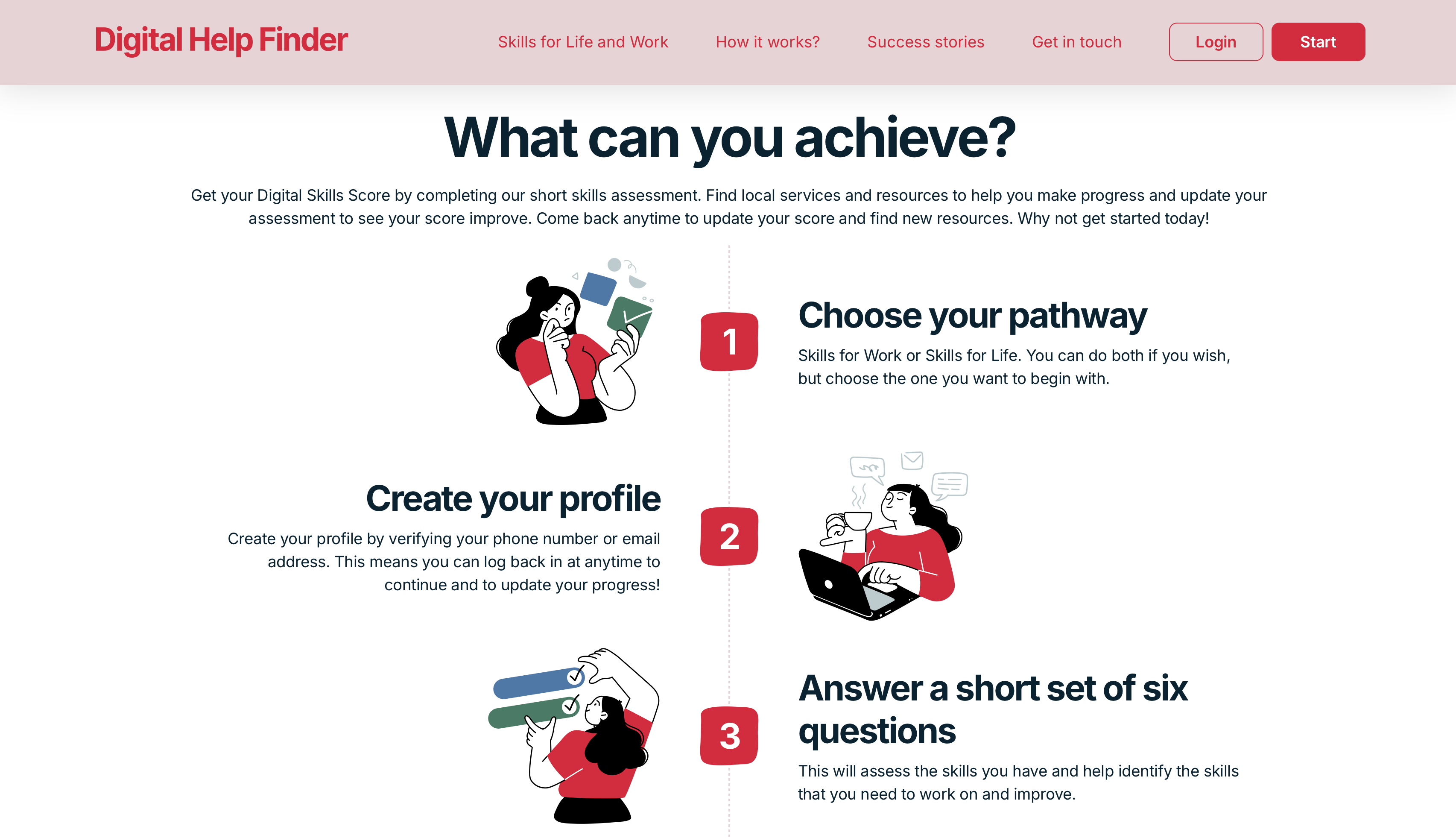
Alongside the multi-authority expansion, the programme is driving a significant evolution of the Digital Help Finder itself through the introduction of a new customisable pathways module. This module gives local authorities the ability to design and deploy learning pathways tailored to the specific needs of their residents and the priorities of their local digital skills programmes.
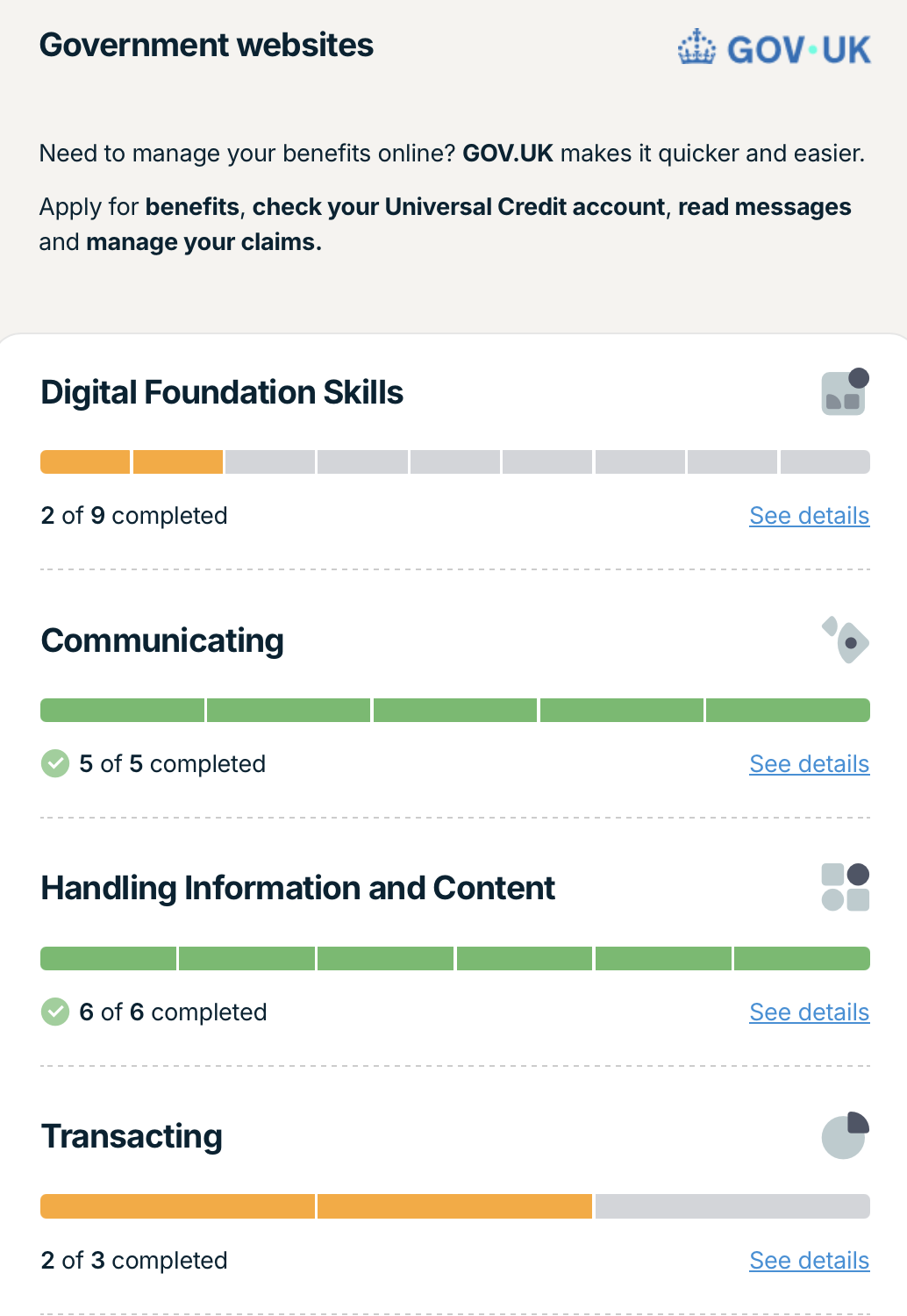
As part of this release, three new nationally relevant pathways have been developed, each focused on an area where digital skills directly improve access to essential services and employment prospects:
- NHS applications — supporting users in developing the skills they need to access and navigate NHS digital services, including appointment booking, the NHS App and online consultations
- Gov.UK platforms — helping residents build the confidence and capability to engage with government services digitally, from Universal Credit to DVLA and HMRC platforms
- Financial and banking applications — equipping users with the skills to manage their finances online, including internet banking, payments and financial management tools
These pathways reflect the real-world contexts in which digital skills matter most for people's everyday lives and economic participation. By structuring learning around practical, recognisable goals rather than abstract competency frameworks, they are designed to be accessible, motivating and directly relevant to the users they serve.
Supporting local authorities to make the case for investment
The SROI model and business case toolkit that emerge from this programme are designed to be directly useful to anyone making the argument for digital skills investment at a local or regional level. The challenge for many local authorities is not convincing people that digital skills matter — it is demonstrating, in the language of finance and governance, that investment in digital inclusion delivers measurable, accountable returns. That is the gap this programme is built to close.
By building the evidence base across five diverse local authorities — urban and rural, coastal and inland, with different demographic profiles and different existing levels of digital skills infrastructure — the programme will produce findings and tools that are broadly applicable and credible across a wide range of contexts. The goal is a model that local authorities can use with confidence when presenting to elected members, ICB partners or central government, and that can be updated and extended as further data becomes available.
If you are working on a digital skills or digital inclusion programme and want to understand how the Digital Help Finder could work in your area, or how the SROI model might support your investment case, we would be delighted to hear from you. Please get in touch.